
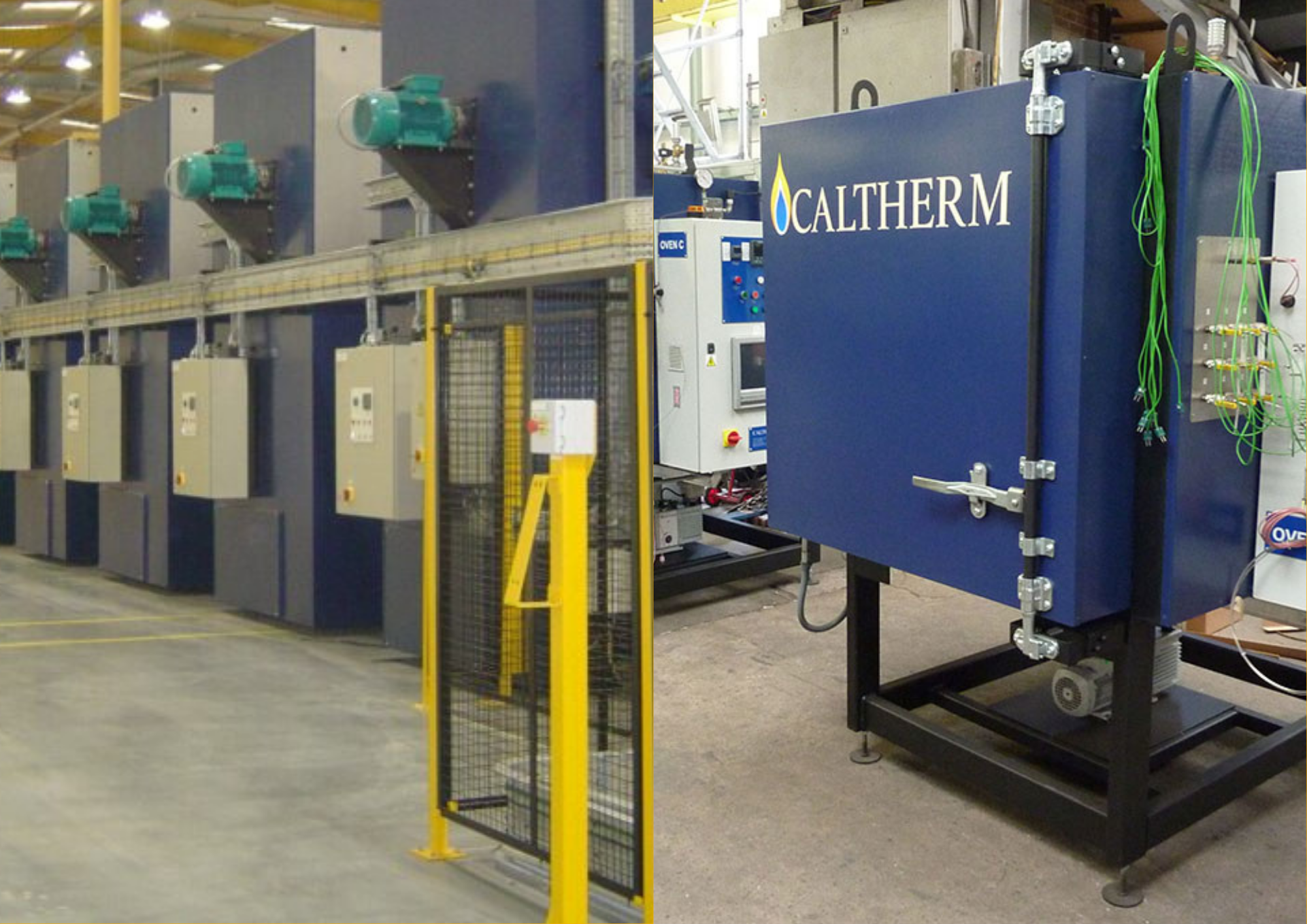
Here’s the short answer. A curing oven uses controlled heat and circulating air to trigger a chemical change that hardens a material, such as paint, powder coating, resin or adhesive. A vacuum oven removes air and pressure from the chamber, which lets you dry, degas or process materials at much lower temperatures without oxidation.
One adds energy to make a reaction happen. The other removes the atmosphere so a sensitive process can happen safely.
That’s the difference in two sentences. But if you’re weighing up an investment in industrial oven equipment, you’ll want more than a headline. So let’s look at how each one actually works, where each one earns its keep, and how to decide which belongs on your shop floor.
What Is a Curing Oven?
A curing oven is a heated chamber, usually a box oven or batch oven, that holds parts at a precise temperature for a set time so a coating or material can cure fully.
Curing isn’t the same as drying. Drying just removes moisture. Curing causes a permanent chemical change, a process called cross-linking, where polymer chains bond together, and the material hardens for good.
Think of it like a two-part epoxy on your workbench. Mix it and leave it cold, and it stays tacky for hours. Warm it up, and it sets rock hard in minutes. A curing oven does exactly that, but at an industrial scale and with tight, repeatable control over temperature and time.
How a Curing Oven Works
Most curing ovens use forced air convection. Heated air is circulated evenly around the load by fans, so every part of every component reaches the target temperature. Uniformity matters here. If one corner of the chamber runs 15°C cooler than the rest, coatings in that corner under-cure, and you get soft spots, poor adhesion or failed parts.
Typical curing temperatures sit anywhere from around 120°C for many powder coatings up to 200°C or higher for certain resins and composite systems, held for a defined dwell time.
What Curing Ovens Are Used For
- Powder coating and paint curing. A paint or powder curing oven melts and cross-links the coating into a tough, durable finish.
- Composite curing. Composite curing ovens harden resin systems in carbon fibre and glass fibre parts, often under vacuum bag consolidation, for aerospace, motorsport and marine work.
- Adhesive and encapsulant curing. Bonded assemblies, potted electronics and sealed components.
- Rubber and plastic post-curing. Stabilising moulded parts after production.
If you run high volumes, curing can also happen on a continuous basis using conveyor ovens, where parts travel through heated zones on a belt.
What Is a Vacuum Oven?
A vacuum oven is a sealed chamber connected to a vacuum pump. Before or during heating, the pump draws the air out, reducing the pressure inside to a fraction of normal atmospheric pressure.
Why bother removing the air? Two big reasons.
First, liquids boil at lower temperatures under a vacuum. At sea level, water boils at 100°C. Reduce the pressure enough and it boils at 30°C or lower. That means you can dry moisture or solvents out of a product quickly and gently, without ever exposing it to damaging heat.
Here’s a real-world analogy. Ever noticed that pasta takes longer to cook at altitude? That’s because lower air pressure lowers the boiling point of water. A vacuum oven takes that same physics and turns it into a precision tool.
Second, no air means no oxygen. With the oxygen gone, materials can’t oxidise, discolour, or degrade during processing. That’s a big deal for electronics, powders, pharmaceuticals and reactive metals.
What Vacuum Ovens Are Used For
- Drying heat-sensitive materials. Electronics, PCBs, lithium battery components, pharmaceutical powders and anything that would be damaged by conventional drying temperatures.
- Degassing. Pulling trapped air bubbles out of resins, silicones, potting compounds and castings before they set.
- Moisture removal from hygroscopic materials. Plastics and powders that absorb moisture from the air.
- Outgassing components destined for high-purity or aerospace environments.
Curing Oven vs Vacuum Oven: The Key Differences
| Feature | Curing Oven | Vacuum Oven |
| Primary job | Hardening coatings, resins and adhesives through heat-driven chemical change | Drying, degassing and moisture removal at low temperature |
| Pressure | Normal atmospheric pressure | Reduced pressure, drawn down by a vacuum pump |
| Atmosphere | Circulating heated air | Little to no air, so no oxygen |
| Typical temperature | Higher, often 120°C to 250°C+ | Lower, because vacuum does much of the work |
| Heat transfer | Forced air convection | Mainly conduction and radiation (no air to circulate) |
| Best for | Powder coating, paint, composites, adhesives, robust metal parts | Electronics, pharmaceuticals, resins needing degassing, delicate or reactive materials |
| Typical chamber size | Small batch units up to walk-in and drive-in ovens | Usually smaller, sealed chambers |
| Relative cost | Lower cost per cubic metre of working volume | Higher, due to sealed construction and pump system |
Temperature: High Heat vs Gentle Heat
A curing oven relies on heat to do the work, so it runs hot and needs excellent temperature uniformity. A vacuum oven lets low pressure do the heavy lifting, so it can process materials at temperatures a conventional oven would consider barely warm.
Atmosphere: Air vs No Air
Curing ovens circulate air deliberately; the moving air is what delivers heat evenly to the load. Vacuum ovens do the opposite. They remove the air, which protects the product from oxidation, but also means heat has to reach the load through shelf contact and radiation instead. That’s why vacuum ovens often heat loads more slowly.
Purpose: Chemical Change vs Physical Removal
This is the cleanest way to separate the two. If your process needs a material to change (harden, cross-link, set), you need a curing oven. If your process needs something removed (moisture, solvent, trapped gas) without damaging the product, you need a vacuum oven.
Which Oven Do You Actually Need?
Ask yourself three questions.
1. What happens to the material during your process?
If it hardens, sets or cures, that’s a curing oven. Powder coating lines, composite shops and adhesive bonding operations almost always land here.
If moisture, solvent or trapped air needs to come out, and the product can’t take much heat, that’s a vacuum oven. Electronics manufacturers, battery producers and pharmaceutical processors usually land here.
2. How heat-sensitive is your product?
Sturdy metal fabrications, automotive parts and structural composites handle high temperatures comfortably. Circuit boards, active ingredients and thin polymer films don’t. The more delicate the product, the stronger the case for vacuum.
3. What throughput do you need?
Curing ovens scale up beautifully, from compact batch units to large walk-in chambers and continuous conveyor systems. If you’re processing pallets of parts per shift, a curing oven layout is usually the practical route. Our guide to integrating an industrial oven into an existing production line covers how to plan this properly.
Vacuum ovens tend to suit smaller, higher-value batches where product protection matters more than raw volume.
Can One Process Need Both?
Yes, and composites are the classic example. Many composite parts are laid up, vacuum-bagged to consolidate the laminate and remove trapped air, then cured in an oven with vacuum lines plumbed into the chamber. Aerospace curing work like this often also needs to meet AMS2750 and Nadcap compliance requirements for temperature uniformity and instrumentation.
Resin casting workshops often do something similar: degas the resin under vacuum first, then heat-cure the finished casting.
Buying Considerations Before You Commit
Whichever way you lean, a few things are worth pinning down before you request quotes.
- Temperature uniformity. For curing, especially, ask for uniformity data across the working volume. Uneven curing is one of the most common causes of coating failures.
- Chamber size and loading. Measure your largest realistic part, then think about how it gets in and out. Trolleys, racks, cranes and product handling all affect the design.
- Controls and data logging. Modern process control gives you repeatability and traceability, which matters if you supply audited industries such as aerospace or automotive.
- Running costs and lifespan. A well-specified oven should serve you for decades with proper care. It’s worth reading up on how regular servicing extends the life of your industrial oven before you buy, because maintenance access should influence the design itself.
- Standard vs custom. Off-the-shelf ovens suit standard processes. If your parts, cycle times or site constraints are unusual, a custom-built thermal solution often pays for itself in throughput and energy savings.
The Bottom Line
A curing oven and a vacuum oven aren’t competitors; they solve different problems. A curing oven uses high, uniform heat at normal pressure to permanently harden coatings, resins and adhesives. A vacuum oven strips out air and pressure so you can dry, degas or process delicate materials gently, with no oxidation and no heat damage.
Match the oven to the job: chemical change means curing, careful removal means vacuum, and some processes (like composites) use both.
Still not sure which fits your process? Caltherm has been designing and building custom industrial ovens and furnaces in the UK for over 40 years. Talk to our engineering team, and we’ll help you specify the right thermal solution the first time.
Frequently Asked Questions
Is a vacuum oven better than a curing oven?
Neither is better; they do different jobs. A curing oven hardens materials with heat, while a vacuum oven dries and degasses materials at low temperature without oxygen. The right choice depends entirely on whether your process needs a chemical change or gentle moisture and gas removal.
Can a vacuum oven be used for curing?
Sometimes, yes. Certain resins and adhesives can be cured under vacuum, and vacuum curing is common in composite manufacturing where trapped air must be removed from the laminate. However, for standard powder coating, paint and most adhesive curing, a conventional curing oven is faster, larger and more cost-effective.
What temperature does a curing oven run at?
Most industrial curing runs between about 120°C and 250°C, depending on the material. Powder coatings typically cure around 160°C to 200°C, while some composite resin systems and high-performance coatings need higher temperatures with very tight uniformity across the chamber.
Why do vacuum ovens dry things at lower temperatures?
Because reducing the pressure lowers the boiling point of liquids. Under a strong vacuum, water and solvents evaporate at temperatures far below their normal boiling point, so moisture can be removed quickly without exposing the product to damaging heat.
How much does an industrial curing oven or vacuum oven cost in the UK?
Prices vary widely with chamber size, temperature range, controls and compliance requirements, from a few thousand pounds for compact batch units to six figures for large custom walk-in or conveyor systems. Vacuum ovens generally cost more per unit of chamber volume due to their sealed construction and pump systems. The most accurate route is a specification-based quote from a UK manufacturer.