
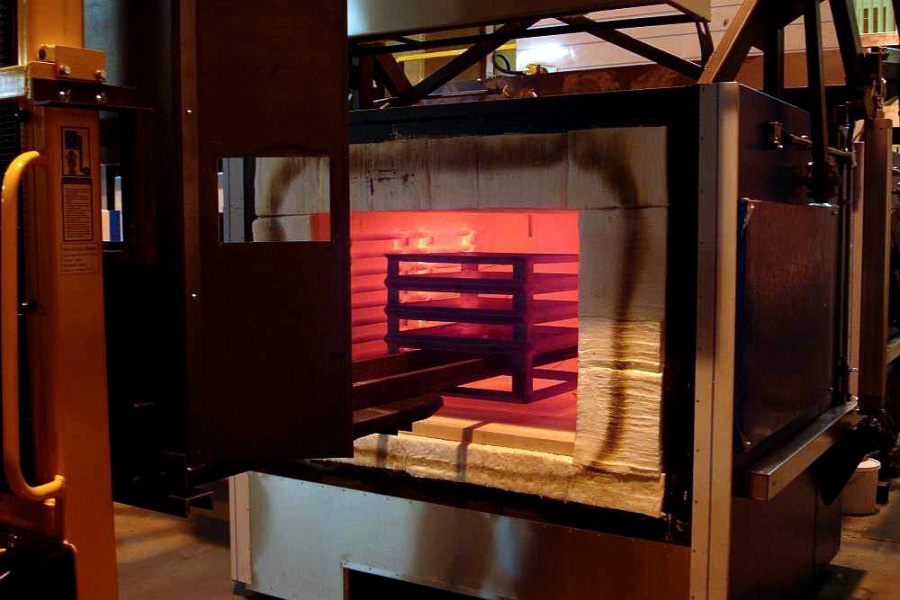
Some furnaces fail within a few years. Others run for decades. The difference almost always comes down to the same five factors.
No two industrial furnaces age the same way. A well-maintained heat-treatment furnace operating at stable temperatures can still be delivering precise results after three decades. A poorly specified or neglected unit might need a full refractory rebuild within five years. The variables are knowable, and they are manageable.
Here is a practical breakdown of each factor, what it does to your furnace, and what you can do about it.
- 15 – 20 yrs Commercial HVAC furnaces under normal use
- 10 – 15 yrs Industrial units with moderate cycling and good maintenance
- 20 – 30+ yrs Heavy-duty furnaces with optimal refractory and process control
- < 5 yrs Units with aggressive chemistry, poor maintenance or over-cycling
Operating temperature and thermal cycling
Sustained high temperatures are hard on every material inside a furnace. Structural metals weaken, heating elements oxidise more quickly, and refractory linings begin to sinter and shift. But temperature alone is not the main culprit. The real damage driver is thermal cycling, the repeated process of heating up and cooling back down.
Each cycle introduces differential expansion and contraction across different materials inside the chamber. Bricks and castable refractories are particularly vulnerable: repeated thermal shock causes micro-cracks that widen with each cycle until sections begin to spall or collapse. A furnace that holds a steady temperature is under far less strain than one that cycles frequently between ambient and operating temperature.
A furnace that runs at 1,100°C continuously often outlasts one that cycles between 200°C and 900°C dozens of times per week.
Maintenance and refractory care
Refractory degradation is gradual, but the consequences of ignoring it are not. A small crack in a hot-face lining allows combustion gases to reach the furnace shell. Shell overheating, deformation, and structural failure can follow, turning what was a routine repair into a full rebuild or premature retirement of the unit.
Routine inspection is the single highest-return maintenance activity available to any furnace operator. Visual checks during scheduled downtime, temperature profiling to identify cold spots that indicate lining failure, and monitoring of energy consumption (a rising baseline can signal degrading insulation) all catch problems while they are still inexpensive to fix.
Combustion equipment also needs regular attention. Burner alignment, air-to-fuel ratios and nozzle condition all affect the temperature distribution inside the chamber. Uneven heating accelerates localised refractory wear and causes inconsistent process results.
Chemical exposure and process atmosphere
The chemistry inside a furnace can be as damaging as the temperature. Every material being processed, and the combustion gases generated, creates a chemical environment that reacts with the lining, heating elements, and structural components.
Acidic fluxes, molten metal splashes, sulphur-bearing fuels, and reducing or oxidising atmospheres each attack the hot face through different mechanisms. Some dissolve the bonding phase of ceramic linings. Others form low-melting eutectic compounds that cause sudden, localised failure. Oxygen infiltration into a furnace intended to operate in a controlled atmosphere can oxidise metallic heating elements rapidly, cutting their service life to a fraction of the design specification.
Matching the refractory chemistry to the process chemistry is as important as matching it to the temperature. High-alumina materials resist basic slags but perform poorly under acidic conditions. Silica linings behave in reverse. Using the wrong material for the application is one of the most common causes of premature furnace failure.
Mechanical load and structural stress
Furnace linings are not designed to carry loads beyond their own weight and the static pressure of the process atmosphere. When heavy charge materials are loaded roughly, when thermal expansion is not accommodated by properly designed expansion joints, or when the furnace structure flexes under its own weight at operating temperature, the refractory bears stress it was not built for.
Cracking, spalling, and deformation of the hot face are the results. In arch-roofed furnaces, crown collapse is a risk if keystone bricks are eroded without timely replacement. In hearth-type furnaces, localised overloading from dense charge materials causes permanent deformation of the floor lining.
Atmospheric control and leak prevention
Even small leaks matter. In furnaces designed to operate in controlled or protective atmospheres, oxygen ingress, however minor, can cause rapid oxidation of heating elements, ceramic fibre linings, and any metallic components in the hot zone. This is especially critical in vacuum furnaces, gas-fired atmosphere furnaces, and any unit processing reactive materials.
Door seals, electrode ports, thermocouple glands, and service penetrations are common leak paths. They degrade gradually under thermal cycling, and the damage they cause is often attributed to heating element failure or lining wear rather than the underlying leak.
How these factors interact
These five factors rarely act in isolation. A furnace running at the upper end of its temperature rating will see accelerated chemical attack, faster refractory wear, and greater mechanical stress simultaneously. Add in high cycle frequency and deferred maintenance, and the lifespan shortens sharply. The inverse is equally true: correct material specification, controlled cycling, and consistent preventive maintenance can push a well-designed furnace well beyond its nominal service life.
Lifespan, in practice, is not a fixed property of a furnace. It is the outcome of every operational and maintenance decision made over its working life.
The furnaces that last longest are rarely the most expensive ones. They are the ones operated within their design envelope, inspected consistently, and repaired early.
Need advice on your specific application?
Caltherm works with operators across a wide range of industrial processes. Whether you are specifying a new furnace or trying to extend the life of an existing unit, our technical team can help.